Showing posts with label Education. Show all posts

Monday, November 16, 2009

ChemMatters podcast - Nanostructures


From the ByteSize Science blog of the American Chemical Society:

The award-winning high school chemistry magazine ChemMatters is making its YouTube debut with its first ever video podcast. The first episode highlights the very big promise of those very small machines known as nanotechnology. The episode explains how incredibly small nanostructures like buckyballs could lead to tiny devices that bring medicine exactly where it needs to go in your body, as well as powerful computers the size of a grain of sand or vital new sources of energy.

Sunday, November 30, 2008

Chemistry in the Community online textbook

I came across a discussion on a homeschool email list of the American Chemical Society's high school textbook Chemistry in the Community (ChemCom) and thought I'd throw it out there for anyone interested. The textbook is muy expensive, but there's a companion website with supplementary student material, including animations, that might be useful even if you don't use the text.

And just a reminder that ACS hold Chemistry Week activities every October, and their website has a page of educational content, including simple experiments for kids.

Sunday, March 9, 2008

The Problem with Homeschool Science Resources

Way back in November, I got a comment about finding hard-to-locate chemicals from Ruth in NC, whose own blog is Traveling Jews, suggesting that I try a company called Home Science Tools. I checked out their website, and was pretty impressed. In fact, we got a microscope from them for the holidays.

But I couldn't bring myself to add them to the sidebar list of suppliers, because of books like the one shown here -- biology curriculum from places like Bob Jones and "God's Design" that teach creation "along with evolution." (If you think this issue just affects homeschoolers, though, see my related blog posts here and here.)

Interestingly, parents whose children have used these texts say their kids score very well on standardized science entry exams for college. (I wonder whether that's a comment on what the tests include...)

I realize that so far, despite the number of resources I've turned up, our chemistry studies this year have stayed on a pretty superficial level. There are lots of homeschoolers who are going through much more rigorous courses than I am. So, what programs do your kids use? How have they worked out?

Saturday, February 16, 2008

Access to Chemistry at Oxford


Oxford University in England has joined the list of colleges offering FREE online courses to the public. Their Access to Chemistry website "provides an excellent resource for prospective applicants to learn more about Chemistry at Oxford from anywhere in the world."

When you click on Pre-University Course, you can page through teaching material based on the book "Chemistry, Matter and the Universe" by Richard E. Dickerson and Irving Geis -- complete with helpful animated illustrations. Here's the introduction:
Many reasons can be given for studying chemistry, ranging from, "It is an intellectual adventure," to "I can make a good living at it," or even "It is required for graduation."

But the most valid response is simple. Chemistry is the study of how matter behaves. We have only one world in which to live. If we want to know how we can change it and what we cannot alter, or even simply to appreciate what we already have, then we must know how it works.

Chemistry is the subject that tells us this. Physics may teach us fundamental facts about elementary particles, matter, and energy, but it stops short of drawing conclusions about how the different kinds of matter around us change and react. Biology describes the large-scale behavior of organisms, which at their core are elaborate chemical systems. Some of the most fruitful advances in biology in the past two decades have come from a thoroughly chemical approach. If we can expand the concept of chemistry beyond our present limited and inadequate knowledge, then biology fundamentally is the highest form of applied chemistry. If chemistry is the study of how matter behaves, we must not forget that we, ourselves, are an integral part of this material world.
This is all part of Oxford's Virtual Chemistry Virtual Laboratory, which includes a 3DChem (a molecule of the month website), LiveChem (a library of nearly 300 videos), and a Webcast Lecture Series of courses such as Dr. Hugh Cartwright's Entertaining Chemistry. Looks to be an excellent resource!

Tuesday, January 29, 2008

Kitchen Chemistry for (Big) Kids


Guacamole, Death by Chocolate Cookies, Scones and Tea ... I can't wait to try some of the recipes, I mean experiments, in the Kitchen Chemistry online course offered by Dr. Patti Christiethrough MIT's Open Courseware website.

Most Kitchen Chemistry is aimed at little kids. This course has you thinking about the molecular basis for building up resistance to the heat of the jalapeno peppers, how copper helps holds together the molecules that make up meringue, and the scaffolding of dough formation.

And from the look of the photo from their class website, it looks like these college students are having fun!

The book used is considered a classic of cooking AND science: On Food and Cooking: The Science and Lore of the Kitchen. I've just added it to my list.

Monday, December 31, 2007

Draw a Scientist Test


How do you find out what kids think of scientists? Have them draw a picture!

This week I was working on a story about CSI and how it's changed public perception. For DAs, the so-called "CSI Effect" has been a problem: juries expect to see the full array of high-tech analyses before they'll convict a defendant (whether it's needed to prove their guilt or not).

But for kids, the "CSI Effect" is different. Researchers have found that the typical scientist as drawn by middle school students is no longer a nerdy white guy in a lab coast with thick glasses and wild hair. In other words, they don't look like the fellow below, from today's Albany Times Union:

A Rensselaer Polytechnic Institute scientist has discovered a fact about mosquitoes that may turn the treatment model for malaria upside down.

"The mosquito is as much a victim as we are, but nobody thinks of the mosquito that way," said Robert Lindhardt, a biochemist and acting director of RPI's Center for Biotechnology and Interdisciplinary Studies.

Instead, they draw scientists who are more "realistic," researchers say. Something like the woman below, who plays a forensic scientist on CSI: Miami, as quoted in yesterday's Parade Magazine:


Q Your item on Emily Procter made me wonder: Why do she and the other women on the CSI shows, such as Marg Helgenberger and Melina Kanakaredes, choose to show so much cleavage?
E.G.J., Lothian, Md.


A “You don’t really think we dress ourselves, do you?” asks Procter. Costume decisions lie with the producers and wardrobe staff, who seem to follow the philosophy “the deeper the cleavage, the higher the ratings.”

Friday, December 28, 2007

An Education Rant


It was probably ten years ago or more than I attended a workshop given by Charles Scaife
, then a professor of chemistry at Union College in Schenectady, NY and his wife Priscilla on doing hands-on science with kids. Talking with Scaife afterwards for a story that ran in one of the local newspapers, I heard how most elementary school teachers have little background in science, and how rarely they feel comfortable teaching it. And that was before George Bush's federal No Child Left Behind school policy put the pressure on teachers to prepare children for high stakes standardized tests in reading and math that leave little room for exploration and wonder. Even after school, homework overload also steals times from kids who might otherwise be messing around with stuff that could lead to scientific insights (but that's another rant). The result Scaife said, was fewer students interested in science in the upper grades, and college freshman who can spit back the right answer without any understanding of the underlying concepts or how to apply them.

I bought Scaife's spiral-bound book of experiments like the ones the couple set out for parents and kids at their workshop to use at home. Although we tried just a few (not always successfully, as seems to be par for the course with use), that evening was definitely the catalyst for this Home Chemistry project we're engaged in this year.

Charles Scaife, whose presentations were the subject of a front-page story in The Wall Street Journal, and subsequent stories in USA Today, the Christian Science Monitor, and Education Week,died in 2003. Priscilla carries on the tradition of introducing the magic of science to children.You can check out the Scaifes' experiments for yourself at the Union College website.

Tuesday, November 20, 2007

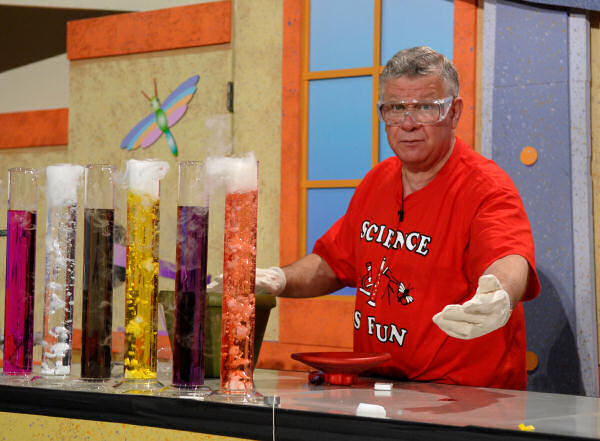
Science is Fun


According to his website, www.scifun.org, University of Wisconsin-Madison chemistry professor Bassam Shakhashiri is "known internationally for his development use demonstrations the teaching of chemistry classrooms well in less formal settings such as convention centers, shopping malls and retirement homes." Shopping malls!

A nice-looking site with Experiments You Can Do at Home, a Chemical of the Week archive, and lists of chemistry books and websites, all suitable for kids middle school and up.

An interesting note: Many of my favorite websites for teaching history to kids belong to elementary or middle school teachers, but so far the best resources for chemistry at home seem to come from college professors. There are also a few good ones for preschoolers and younger kids -- but where are the middle and high school chemistry teachers? Are they all too busy cramming facts into the kids for the SATs?

Monday, November 19, 2007

Chem4Kids


In addition to reading through The Joy of Chemistry together, I'm thinking of having the kids go through this site on their own. I like the way it explains complex topics in simple language, and I think it might help clarify or reinforce concepts like bonding, stoichiometry and even anti-matter! The pages aren't cluttered, and it's got really nice graphics to explain the concepts in a visual way. And there are online quizzes they can take to see how much they actually absorbed.

No experiments this week --we have a bunch of kids coming over for a birthday party, and I've got to put all the dangerous stuff away. But we should start growing crystals next week, for a Hands-On Learning column I'll be writing for Home Education Magazine.

Thursday, November 15, 2007

Sensory Creatures


Went to the Roald Hoffmann talk last night. John (who just turned 15), accompanied me and said he enjoyed it. (It's Hoffmann's wry asides, missing in his video appearances, that make him so engaging in person.) In preparation, we watched the first episode of World of Chemistry online. Then I served two different enantiomers of carvone for lunch: homemade pumpernickel rolls with caraway seeds and spearmint candies. (The rolls came out a little dry; I'll have to find a better recipe.)

In our interview, I had asked Hoffmann what he does to make chemistry more accessible to laymen. He described a typical news item about science, a health story either touting a new miracle drug or decrying the fact that last year's miracle drug has been found to have dangerous side effects. He went on to say
The newspaper will never show a picture of the molecule. They’re deathly afraid to show the molecule. But they will use the name. So when I see that story, I go to Wikipedia and get the structure to show them, and go deeper into the story.
So I made sure to show the kids pictures of the right- and left-handed carvone molecules. And I will try to post images of molecules here whenever possible.

Again, if you can get to the Tang Museum to see the Molecules that Matter exhibit do so, if only to get to walk around the giant steel 3D molecular models. As Hoffmann pointed out last night, computer graphics have pretty much made model-building obsolete. But humans are sensory creatures, and the real-life experience is more profound than the most detailed rotating 2D approximation.