Home Chemistry

Making science fun for my homeschooled kids

Wednesday, May 7, 2008

Surfaces and Density

video

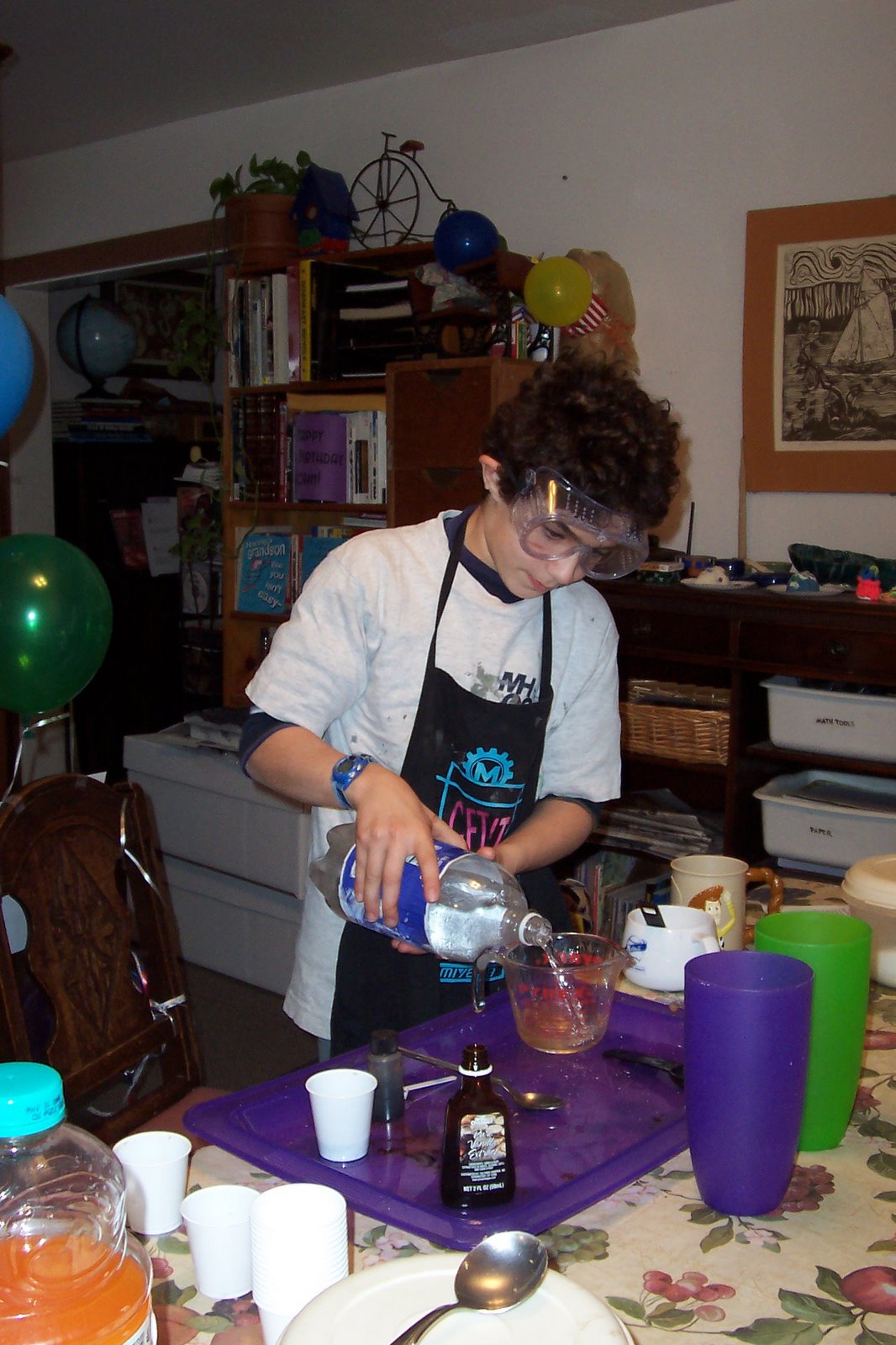
This week we did a number of experiments with oil, water, food coloring and various props to explore the property of surfaces. The physical properties like surface tension and solubility are related to the strength of Intermolecular Forces -- the attractive forces between molecules.

Surface Tension Experiments

These came from the website of the Chicago Section of the American Chemical Society

3 bowls or containers with water
liquid soap
pepper
a piece of string
a paper clip
a fork
a needle

Bowl 1:

1. Sprinkle pepper on the surface of cold clean water in a shallow dish. Allow the particles to spread out and cover the surface.

2. Put your finger in the bowl.

3. Put a drop of liquid soap on your finger. Put your finger in the bowl again.

What should happen: Pepper should rush away from your finger in a star pattern.

What did happen: Pepper rushed away from finger in a circle -- still impressive.

Bowl 2:

1. Float a small loop of string in the middle of the surface of water.

2. Put a drop of liquid soap inside the loop.

What should happen: The surface tension inside the loop of string should weaken by the soap but the surface tension outside the string should have pulled the string outward.

What did happen: The string sank before we could try step 2.

Bowl 3:

1. Lower a paper clip and a needle flat onto the water surface using the fork. They should float.

2. If they don't, place a paper towel on the surface of the water, place the objects on the paper, and then remove the paper.

3. Now put a drop of liquid soap on the water surface.

What should happen: As soon as the tension is broken by the soap, these items should sink to the bottom.

This one worked as planned!

Density Column
Joy of Chemistry, page 131


2 clear glasses or plastic cups
Glycerin
Water
Food coloring
Cooking oil
Liquid soap
Plastic spoon

1. Pour about an inch of water into the cup.

2. Add food coloring to the water.

3. Pour about an inch of glycerin into the second cup.

4. Gently add colored water.

5. Add oil until you get three layers.

6. Stir. Allow to settle.The water will mix with the glycerin, but the oil will separate back out.

7. Add a layer of liquid soap.

8. Stir gently. The oil will mix with the glycerin.

What's Happening: Different liquids have different densities, and according to the density, the liquids will settle in a certain order when mixed. Oil is less dense than water and therefore will settle on top of water.

(NOTE: Glycerin--C3H5(OH)3, which can be bought in drugstores -- can be added to dish soap to make long-lasting bubble solution. Bubbles eventually burst once the layer of water evaporates, but glycerin forms weak hydrogen bonds with water, delaying evaporation. )

Lava Lamp


video

(Sorry that it's sideways. When I figure out how to fix it, I will repost it!)

Tall narrow jar
Water
Food coloring
Vegetable oil
Salt

Directions:

1. Fill the cylinder with water.

2. Add the food coloring. Do not let the water become too dark.

3. Slowly pour oil into the cylinder. It should make a thick layer on top of the water.

4. Slowly sprinkle the salt into the cylinder on top of the oil. The salt coats the oil and causes it to fall to the bottom of the graduated cylinder in globs. The oil will gradually return to the top of the graduated cylinder.

What happened:

Vegetable oil is less dense than water. When the salt is added, it sticks to the oil and drags it down. Once at the bottom, the water dissolves the salt and the oil floats back up.

The reason the oil doesn't dissolve into the water happens because of its difference in polarity. Water and salt are both polar. Oil is non-polar. Only polar substances will dissolve polar substances. A non-polar substance will not dissolve in a polar substance. This is the rule of "like dissolves like."

Tuesday, April 29, 2008

Testing week

Home Chemistry experiments are on hiatus this week for state-mandated standardized testing for the kids (and so Mom can catch up on writing deadlines). Posts will resume soon! In the meantime, a joke:

Q: Why are chemists great at solving problems?
A: They have all the solutions.
More chemistry jokes (and explanations) here.

Monday, April 21, 2008

Paper Mache and Gluten

Mixed up some flour paste for a paper mache project I'm going to be working on this week. According to The Papier Mache Resource, it's the gluten in the flour that makes it sticky. The Exploratorium has an animation that shows how the protein molecules line up to form a gooey elastic mess. My batch developed a sticky skin that I skimmed off -- hopefully the remaining liquid is goopy enough!

Description of image, borrowed from ChemConnections:


Molecular model of the spiral structure formed by the HMW subunits of glutenin.

Wednesday, April 16, 2008

Endothermic Reactions


As a continuation of our foray into heat-producing (exothermic) chemistry, we mixed up some solutions that became colder (endothermic). Endothermic reactions involve electrons jumping to higher orbitals, which requires an input of energy. The atoms absorb energy in the form of heat from the surrounding environment, thereby lowering the temperature. Unfortunately notetaking that day was not optimal, but here is an idea of what we did:

Since we didn't have the recommended styrofoam cups for mixing our solutions -- which I assume were supposed to provide some insulation between the solution and the air temperature around it -- we used doubled-up paper coffee cups (just like my favorite coffee shop). We used a meat thermometer I found around the house (purchased for a greenhouse gas experiment I never got around to doing) and a 99 cent house thermometer I picked up at Wal-Mart. All the experiments dropped a few degrees almost immediately, going from a water temperature of about 60 degrees Fahrenheit (sorry, we're working in an American kitchen, not a lab with metric measurements) to about 55 or 50 in a minute or so. You could just barely feel the difference by putting your finger in it (we totally forgot gloves and eye protection for this one), so the thermometer is a must.


First was potassium chloride, found in salt substitute. We mixed in an unmeasured proportion with tap water.


Next, we cut open a cold pack from an old first-aid kit. The cold-pack consisted of two compartments, one containing urea (or crystalized peepee, used in cigarettes, pretzels, bath oils, cloud seeding, and tooth whitening -- although I think they make it artificially!) and the other water. You're supposed to squeeze the water portion, which I guess forces it into the other portion. We just poured the crystals into a cup and added water.


The third mixture was baking soda and citric acid. We only had a small jar (scavenged from some old science kit, I believe) so we put about half a teaspoon in the cup and mixed with a little water. Then we poured in some baking soda. It fizzed up nicely, of course, as it would with vinegar. According to about.com, the reaction was:
H3C6H5O7(aq) + 3 NaHCO3(s) --> 3 CO2(g) + 3 H2O(l) + NaC6H5O7(aq)


Finally, we mixed some calcium chloride -- the kind of road salt used to melt icy sidewalks -- with water. Surprise! This one turned out to be exothermic. The temperature went up to 78 degrees. Pretty neat.

Monday, April 14, 2008

Your name in elements


Theodore Gray, creator of the lovely Periodic Table Table, emailed me today with news of his element banners. The idea is to spell words or phrases using only the one- or two-letter element abbreviations, then illustrate the spelling with photos from the poster of his table. The banners are pricey, but you can have fun just seeing how your name looks in elements. See a different version of my name here.

Crossposted to GeekDad.

Sunday, April 13, 2008

Elementeo


Elementeo is a strategic battle game where you use your elements across the battlefield in reducing opponent’s electrons to zero. You do that by harnessing the strength and moving properties of the elements and compounds, and by using their reactionary powers. For example, Oxygen can rust any neighboring metal or Copper Conductor can shock any metals and send them back to the deck. According to the game's inventor, Anshul Samar, an eighth grader:
Each card has fantasy, education, and fun all mixed in. From the educational side, one card contains the atomic number, elements family, atomic mass, state at room temperature, oxidation state, and symbol of one element. Compound cards include formulas and how dangerous or flammable the compound is in our world. Alchemy cards go over a wide range of chemistry and physics subjects.
The game should be available the end of this month at the Elementeo website.

Thanks to my friends at Geekdad!

Thursday, April 10, 2008

Nitric Acid and Ethanol

Tonight we saw an episode of "The Simpsons" where Bart lets loose a python in the school chemistry lab. A flask full of ethanol is knocked over, followed by a flask full of nitric acid (labeled "Do Not Mix with Ethanol"). The combination forms a toxic gas.

The Simpsons is known for sprinkling math and science references throughout its scripts. (See Paul Halpern's book, right.) That's because many of the show's writers have advanced degrees in the subjects, including writer Bill Odenkirk, who has a Ph.D. in chemistry and George Meyers, who holds a degree in biochemistry from Harvard. In this episode, first aired last May, a math textbook gets shot and "bleeds" equations, and physicist Stephen Hawking makes an appearance in a flying wheelchair.

However, it turns out that the writers got this one wrong, as noted in this entry on tv.com:

When nitric acid & ethanol are mixed in this episode it produces a toxic gas. In fact, mixing these two chemicals will make a very explosive mixture, not a toxic gas.
Or if you don't care to rely on chemistry facts from a TV website, here's a more reputable source.